
Growing up in Seattle, Whittaker and his twin brother, Lou, were Boy Scouts, where they learned to climb mountains, starting at age 12. The boys completed their first summit of the nearby Mount Rainier at 16, and had climbed all of the major peaks in Washington by 18. In 1955, with that experience Jim became the first full-time employee at a local sporting goods co-op, the Recreational Equipment Cooperative, formed to help climbing enthusiasts get good prices on their equipment. The company is now better known as REI Co-Op.
In 1953, Sir Edmund Hillary (aided by Sherpa Tenzing Norgay) was the first to summit Mount Everest, bringing mountain climbing into focus worldwide. By the end of the 1950s, only four others had successfully summited Everest. By the time Whittaker joined the first American expedition to Everest in 1963, only three others had made it, all from the 1960 Chinese expedition. It was a tough climb, particularly getting past the Khumbu Icefall, one of the most dangerous sections of the South Col route to the summit, and not far from the base camp.
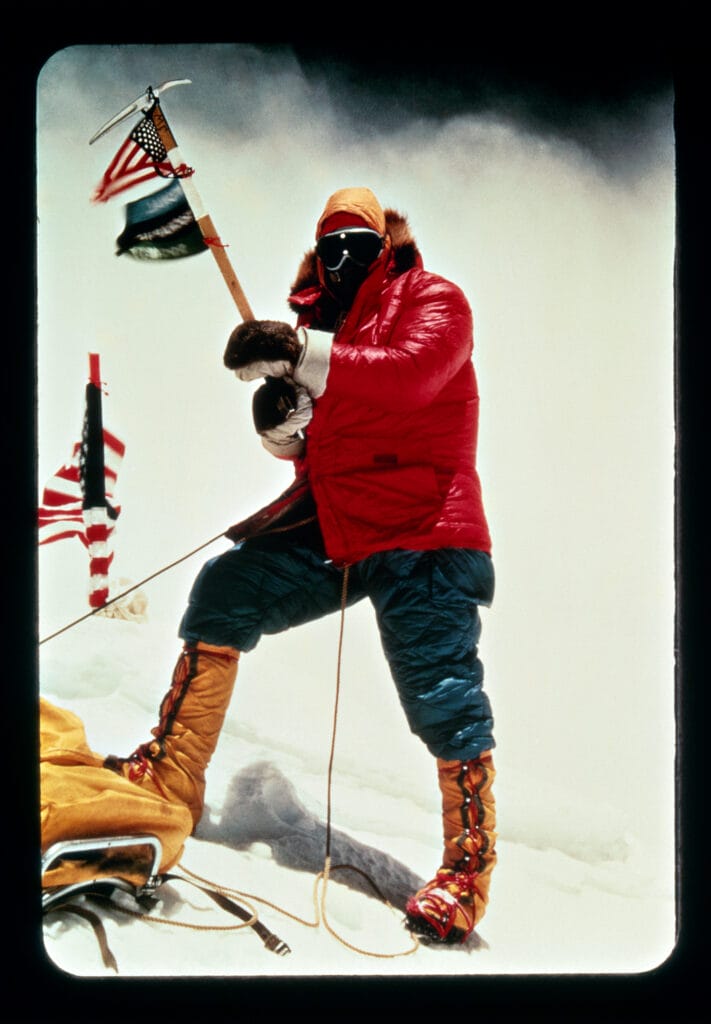
“The icefall is a living, moving, groaning, white fang homicidal mass of glacial debris,” Whittaker wrote. One member of the expedition was killed when an ice shelf fell on him; his body was never recovered. The team pressed on, and Whittaker was the first American ever to summit Everest, aided by Sherpa Nawang Gombu. The successful climb was huge news in the U.S., and REI was carried along in the publicity; in 1964, the company’s gross revenue exceeded $1 million for the first time (2021 revenue: $3.7 billion).
Months after the successful climb, President John F. Kennedy was assassinated, and the the following year the Canadian government named the highest mountain peak in Canada that had not been climbed nor named, Mount Kennedy. “I believe it is appropriate that Canada’s memorial to him should be a mountain,” said Prime Minister Lester B. Pearson. “A mountain is solid and enduring. Mount Kennedy is a graceful, towering, unencumbered peak … a symbol of aspiration and upward reach.” The National Geographic Society sponsored a team to summit the mountain. For the expedition leader, they chose Whittaker, who led Kennedy’s brother, Robert F. Kennedy, to the top.
Kennedy left his brother’s PT-boat tie clips, a copy of the president’s 1961 inaugural address, and a JFK medallion at the peak. Whittaker and RFK remained friends to the end of the politician’s life. When Whittaker wrote his memoir, A Life on the Edge: Memoirs of Everest and Beyond *, published in 1999, Robert F. Kennedy Jr. wrote, “My father’s greatest living heroes were John Glenn and Jim Whittaker — a physical giant with a huge heart, a decent soul, and inspirational courage. We can all be grateful that Whittaker has finally put his extraordinary life on paper. Whittaker’s story is a riveting saga of high adventure by one of history’s greatest climbers.”
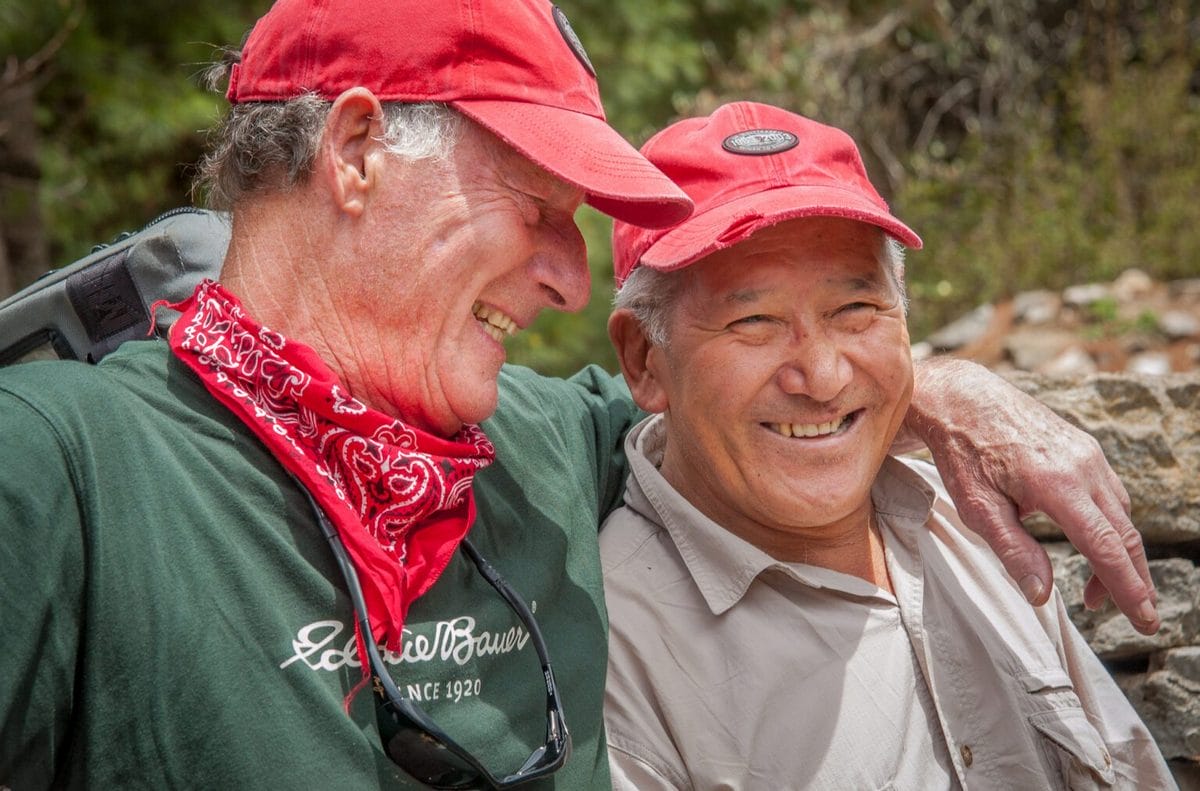
In 1971, Whittaker was made President and CEO of REI. He retired at the end of 1978, but continued to live an outdoors life, building a home in the woods overlooking Port Townsend Bay that his friends called “Taj Macabin”. In 1996 he took his sons out of school so the family could sail from Washington to Australia, and back. It took 4 years. “Seldom do you have one person epitomize the most admired, treasured and inspiring value of a whole state,” said former Washington Gov. Jay Inslee, “and that’s what Jim Whittaker does.” Lou, who was a long-time mountain guide, died on March 24, 2024, from congestive heart failure, at 95. James Warren Whittaker died on April 7 at his home in Port Townsend, at 97.