
Born in Minneapolis, Minn., Kibrick’s family shortly after his birth moved to Los Angeles in hopes his father could find better work. At age 5, “My mother took us to Grauman’s Chinese theater and after the movie, a man came over to us, pointed at me, and said he could ‘use that little kid in the movies’,” he recalled in an interview decades later. Kibrick’s 4-year-older brother, Leonard, was also signed. Sidney’s first role was as an extra in a feature comedy, Dead End (1933), when he was still just 5. He landed about six minor roles in films with Shirley Temple, Buster Keaton, and Henry Fonda, before getting his real break in 1935.
That break was moving into what brought in the real money for kids in that era: being cast in the “Our Gang” series, which started in 1922 — the silent era. Creator Hal Roach’s idea was to make short films of kids mostly acting naturally, though obviously in scripted situations, rather than pretend to act like adults. He had previously tried a series starring a Black boy, but theater owners balked at the concept. Still, that idea survived some in Our Gang, which featured a few Black kids, who had roughly equivalent roles as the white kids. The concept worked pretty well, but the series really took off when Roach switched to sound in 1929 so viewers could hear the kids talk. Kibrick’s brother was cast into the series in 1934, and a year later Sidney was brought in too. During the height of the series, “I was earning $750 a week in ‘Our Gang,’ which was a lot in those days, especially during the Depression,” he said. In 1939, $750 was the equivalent of around $17,000 today. He was initially an unnamed character, but was later dubbed “Woim” (Worm), the sidekick of the main antagonist, Butch (Tommy Bond).
“We’d have two hours of schooling in the morning and then work anywhere from six to 16 hours until we finished,” Kibrick said a few years ago. “There was a lot of work, no question about it, but our director Gordon Douglas was a terrific guy and he was really able to get a lot out of each kid.” When not needed for shooting, the kids could — and did — play. “There was a big pond at the studio, so Spanky [George McFarland] and I would go fishing a lot,” said Kibrick. “Parents had to be on the set at all times,” so the kids rarely got into trouble. “We had scripts and had to rehearse before shooting so it was very structured.” Which doesn’t mean there was no tension at the studio. “Alfalfa [Carl Switzer] was a very difficult kid and created a lot of problems on the set. He was not nice — not only to the gang, but to the boys and girls who were extras in the movies. It was just his nature. Years later, he was killed in a fight, so he was basically a tough kid.” Actually, in 1959 Switzer was shot to death in a business dispute at 31.
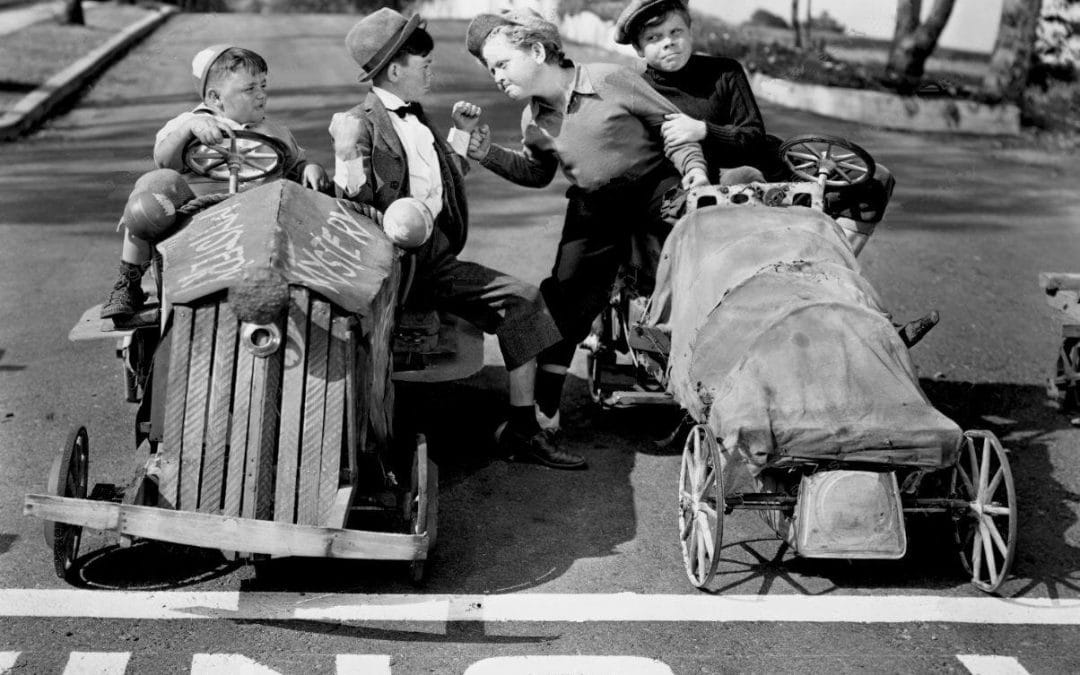
Kibrick’s bond with McFarland lasted. “We developed a lifelong friendship and although he moved to Dallas [years later] while I lived in Beverly Hills,” he said. “We used to visit and stay at each other’s homes time and time again over the years.” McFarland died in 1993, at 64. While the money was good at Our Gang, after several dozen appearances Kibrick was bored. “By the time I was 15, I’d had enough. My parents wanted me to continue but finally my mother went along with my wishes.”
He still worked in a few more film roles before fully retiring from films as a teen. “I later attended college and became a real estate developer. So I had a very successful post-Hollywood career,” he said, fully aware that he escaped the trouble that beset many child actors — such as Switzer. The last of 220 Our Gang shorts was released in 1944. Kibrick, who grew up to be quite tall, did well in real estate. Leonard returned to acting after a 44-year hiatus for a guest spot on Hill Street Blues (1986) and several other guest spots, ending with L.A. Law in 1990. Leonard died from cancer in January 1993 at 68. Sidney Henry Kibrick, the last surviving actor who played a featured Our Gang character, died in a hospital in Northridge, Calif., on January 3, at 97.