
Born in Oregon, Brainerd’s family ran a camera shop and photographic studio, giving him a background in visual arts; he went on to work on his schools’ yearbooks, which gave him an interest in publishing. “My father sent me off to professional photographer’s school when I was a junior in high school,” he told an interviewer for the Museum of History & Industry in Seattle in 2009. “I was 16 years old and I went off to Winona, Ind., for part of a summer to learn from professional photographers from New York and San Francisco. It was an incredible experience. I was the youngest student they’d had in years.” It also gave him an interest in journalism. He went on to earn a BA in business administration from the University of Oregon (“It was what we could afford,” he laughed), working his way through school as a photographer. He minored in journalism, where he worked on the school newspaper. “We had to set all the type on Linotype machines,” he remembered — the machines cast lines of type out of molten lead.
He wanted to go to graduate school. “The University of Minnesota came through with a complete free load, in terms of tuition, and a stipend — small one, a few hundred dollars a month, but enough to pay for room and board.” He earned a Master of Science in journalism there, and went on to work at the Minneapolis Star-Tribune newspaper not as a reporter, but in operations — “responsible for the planning and implementation of technology in the pre-press area — everything up to the plate-making room, all the typesetting, production, advertising, editorial, was all in that domain.” His bachelor’s degree made him perfectly suited for that. A chat with a mentor made him decide that he didn’t want to be a journalist: he was much more interested in the technology behind publishing. He realized “I could bridge the gap between the people who created technology — the engineers, the bits-and-bytes people — and the people that use the technology.”
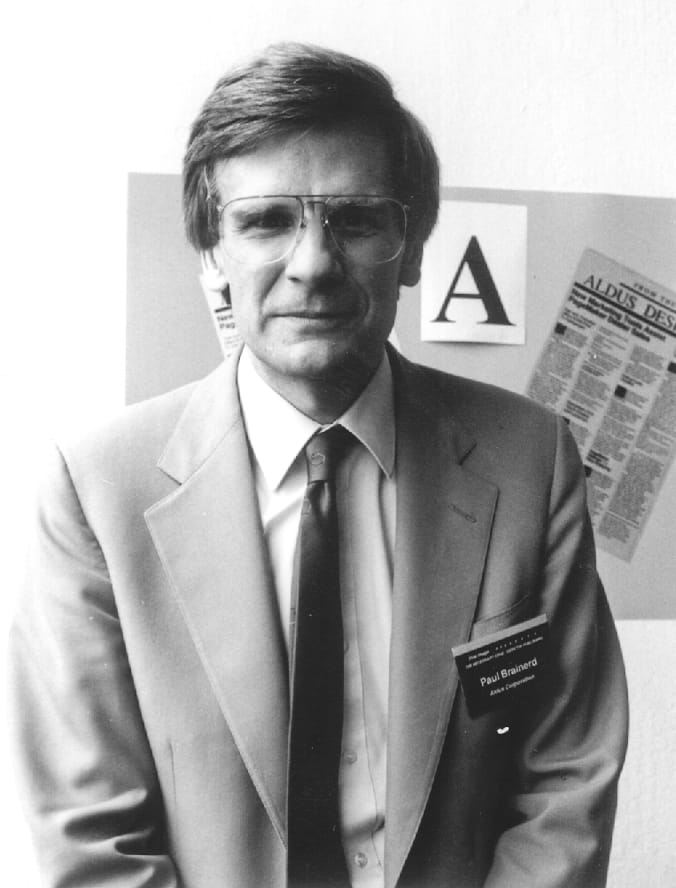
So he quit the newspaper to work at a company that developed hardware and software for news publishers: Atex. The company was part of the revolution in the change from “hot lead” type from Linotype machines to phototypesetting, and later computer-to-plate systems, driven by “VDTs” — video display terminals where reporters would enter their stories, rather than pound them out on typewriters. It was a revolutionary system that ran on a Digital Equipment Corp. PDP-11 minicomputer. One of their early big clients: the Minneapolis Star-Tribune. The company soon promoted him to take over its research division in Redmond, Wash. — he was happy to get back to the west coast — in “about 1982–83.” In early 1984, the company was bought out by Kodak, which made an interesting decision: it shut down the Redmond division. “They’d just paid several tens of millions of dollars — 60 million or something — to buy this company. And they closed down the division that was working on the future in technology. Made no sense.” He was laid off, and joined with four engineers — Jeremy Jaech, Mark Sundstrom, Mike Templeman, and Dave Walter — to come up with something new.
They decided to start their own company. “I’d put away about three or four thousand dollars. Took the money I got from Kodak stock, sold the shares. Put that into an investment into the new company. We gave ourselves six months.” Their big idea: ditch the expensive minicomputer and base a new page-making system on personal computers. The then-new Apple Macintosh, with its native graphical user interface, would be the perfect platform. Naming their new company after the 15th-century Venetian printer Aldus Manutius, known for standardizing the rules of punctuation and also inventing italic type. Aldus Corp. was founded in Seattle in February 1984, and their software was ready by July: PageMaker, which output camera-ready pages on the Mac’s PostScript-based laser printer, the LaserWriter. In 1985 I used PageMaker to lay out my first book (about the Dvorak keyboard) on an original Mac, printing the pages on a LaserWriter at 125% so that when it was photographed by the book printer for the plate negatives and reduced back to the proper size, it would tighten up the 300 dpi printer output and be sharper.

Brainerd himself coined a new term to describe what the software enabled: “desktop publishing.” Atex couldn’t compete: it had shut down its own R&D division that Brainerd was running! PageMaker was a huge hit, and was ported to Windows 1.0 in 1987. (“We were actually the first major Windows application,” he said. “We beat Microsoft development with PageMaker: it was out before Microsoft Word was out under Windows. Not too many people know that. Bill [Gates] and Steve [Ballmer] sent us a bottle of Dom Pérignon champagne. I can remember celebrating the fact that the first major Windows application had shipped.”)
The software won a Codie award for “Best New Use of a Computer” in 1986. In October 1986 a version of PageMaker was made available for Hewlett-Packard’s HP Vectra computers. In 1987, PageMaker became available for DEC’s VAXstation computers, eating Atex’s lunch in the large publisher market. After 10 years of running the company — growing it from 5 employees to over a thousand — Brainerd was tired. “I went to the board and basically said, ‘It’s time for me to step down. I need somebody to come in and take my place’.” They tried to hire someone, but it’s difficult to replace a founder. So, “I approached Adobe.” Adobe, which had created PostScript, was a natural. PageMaker finally had a strong competitor, QuarkXPress, and PageMaker would give Adobe tighter control over the publishing workflow built on its own PostScript and font technologies. Buying Aldus would also give Adobe control over Aldus’s graphics tools, and more importantly, the company that had helped define the industry in the first place. Aldus agreed to a merger, completed in 1994, for about $446 million in Adobe stock. As a software package, PageMaker eventually faded away, but the line of development led directly to Adobe InDesign, which remains a central tool in professional publishing today.

Brainerd put a big chunk of his sale proceeds into endowing the Brainerd Foundation to fund regional non-profits who would build a lasting conservation ethic to the Pacific Northwest. He brought an entrepreneurial focus to that, too. Particularly with “Seeking feedback. Going out and evaluating what we’ve done and how we could do it better. It’s particularly true when you’re handing out money, because you’re everybody’s friend. No one wants to offend you because you’re writing the checks to these organizations. So, it’s particularly important that you think about how you can get honest feedback. People will give it, but you can’t necessarily be the one asking the question. You have to get third parties to go and ask questions and so forth. We constantly do that, not necessarily with every last grant, but nearly so: at least half or more. We seek third-party evaluation of the grant. What went well? What could we have done better? Did it actually achieve the purposes that we sought to achieve?”
After the environment, education was his second interest. “I would be in the camp that says that is a public good, and we do need to tax ourselves and invest in it, and do it smartly. So, I’m an interesting mix, because I bring the business equation to the table and expect results and accountability and reflection and measurement, and at the same time, I’m willing to trust that there is a possibility that the government can do well and do good things; and, that there’s a role for the private sector as well.” No one ever said he tackled tiny problems. Brainerd died at his home on Bainbridge Island, Wash., on February 15, from Parkinson’s disease. He was 78.