
Born in Seattle, Stavenhagen and her family moved often, around the U.S., and to Denmark in her teens. She was active, enjoying dancing and competitive swimming. She came back to the U.S. for college, earning honors with a triple major (French, Political Science, Comparative Literature) in 2015. With a French boyfriend, Hugo Taubmann, her goal was to split her time between New York and France, and started work toward her Master’s degree at École des hautes études commerciales de Paris — the Paris School of Advanced Business Studies — and started work as a consultant with Ernst & Young’s Paris operations.
Life was going well, though Stavenhagen had been noticing some weird things going on. In 2018, “I began waking up in the middle of the night with leg cramps. Being 25, I joked to friends that I felt like my grandmother.” She took magnesium supplements. When France won the World Cup, “I ran through the streets of Paris celebrating.” Then she started falling. “I was an active 26-year-old so why did I feel like my feet couldn’t quite keep up?” She went to her doctor, and was referred to a neurologist. There, “I learned that I likely had ALS” — amyotropic lateral sclerosis — “and a 2–5 year life expectancy.”
A family friend, a doctor, scoffed. “You’re a young woman,” he proclaimed. “There’s no way you have ALS.” Indeed most people diagnosed with ALS are older men. She finished up her thesis and got her master’s degree, and Stavenhagen and Hugo moved back to the U.S. for tests, and medical treatments. During that time, she still wanted to travel, including Germany, Switzerland, Turkey, and Croatia. “I was doing my best to ignore the immense ALS raincloud that was hovering above.” Between trips, she would spend time in the hospital, getting tests, which confirmed the diagnosis: ALS. She also married Taubmann.
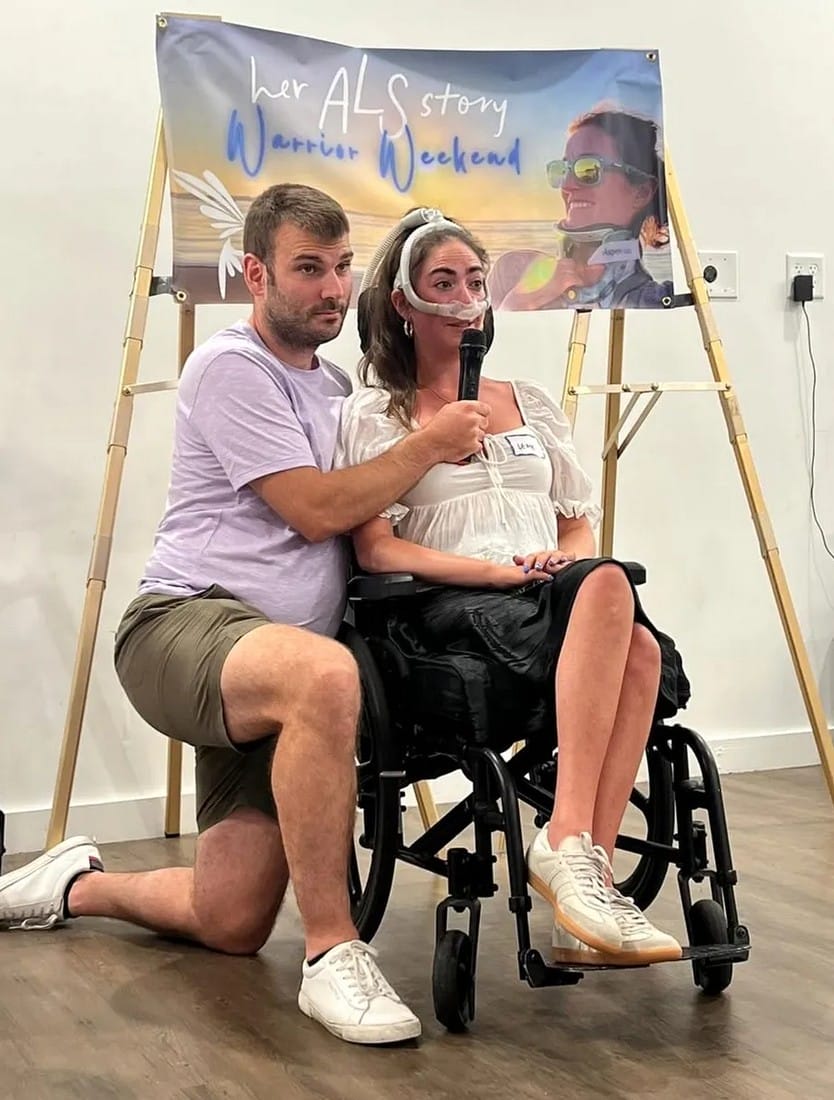
In 2021, tired of hearing that young women can’t get ALS, Stavenhagen founded a support group, Her ALS Story, which “seeks to raise awareness that ALS impacts young women.” Women diagnosed before 35 can join “a community for them to connect, learn from each other, and find support so they can live their best lives.” The organization is run by the members: there are about one hundred of them now. Humor runs through the group, says member Sunny Brous, of Texas. She asked in the chat group if anyone was giving anything up for Lent. “The answers were, ‘Yeah, the use of my arms!’ ‘Feeding myself.’ ‘Walking.’ ‘Talking.’ We try to celebrate small things, like that it’s been a week since I peed in my pants. That’s a big thing in our world.”
Stavenhagen still worked for Ernst & Young. “I readily worked on proposals and discussed future plans with colleagues but, in the back of my head, knew that I would no longer be working by the time they came to fruition.” In 2022, she wrote and published a memoir of her story of finding love amid getting a fatal diagnosis. It’s in French: J’Aimerais Danser Encore (“I Would Love to Dance Again”) *.
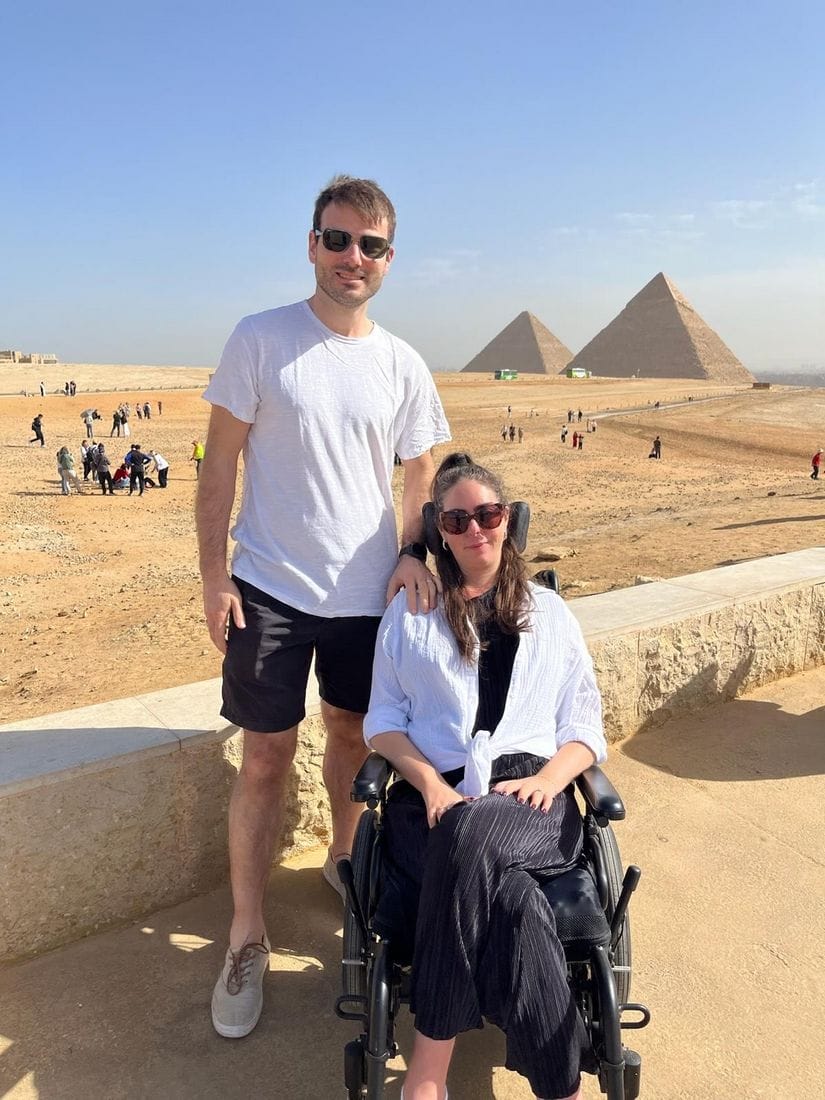
Leah Miriam Stavenhagen died on a trip to Egypt with Hugo on February 20, at 33. “Leah was such a fighter,” said her mother, Susan Stavenhagen. “She had us fooled by her energy, joie de vivre, and desire to live as normally as possible, so that we often lost sight of how vulnerable she was.”