
Born in Virginia, Gladys Mae Brown grew up in a family of sharecroppers, and was expected to work in the fields. In addition to working in the fields themselves, her father worked for the railroad, and her mother worked in a tobacco factory. Gladys viewed education as her way out to a better life. “Every day I wished and dreamed of having more,” she wrote in her autobiography — “more books, more classrooms, more teachers, and more time to dream and imagine what life would be like if only I could fly away from the strenuous and seemingly never-ending work on our family farm,” so she “made a commitment to be the best I could be and absorb as much knowledge that a little farm girl could handle” because “I realized I had to get an education to get out.”
There were two keys for her: she had a mind for math, constantly counting things, sorting them in her mind, and — particularly — an aptitude for geometry. Her teachers urged her to study math. The second key: at her high school, the top two students from each graduating class received full scholarships to Virginia State College (now Virginia State University). West graduated as valedictorian in 1948, and received the first of the two scholarships. She did study math, graduating with a bachelor of science degree in the subject in 1952. She taught for two years to save money, and then returned to the school for her Master of Mathematics degree, which she received in 1955. In 1956, West was hired by the Naval Proving Ground in Dahlgren, Virginia (now the Naval Surface Warfare Center Dahlgren Division). “That’s when life really started,” she said.
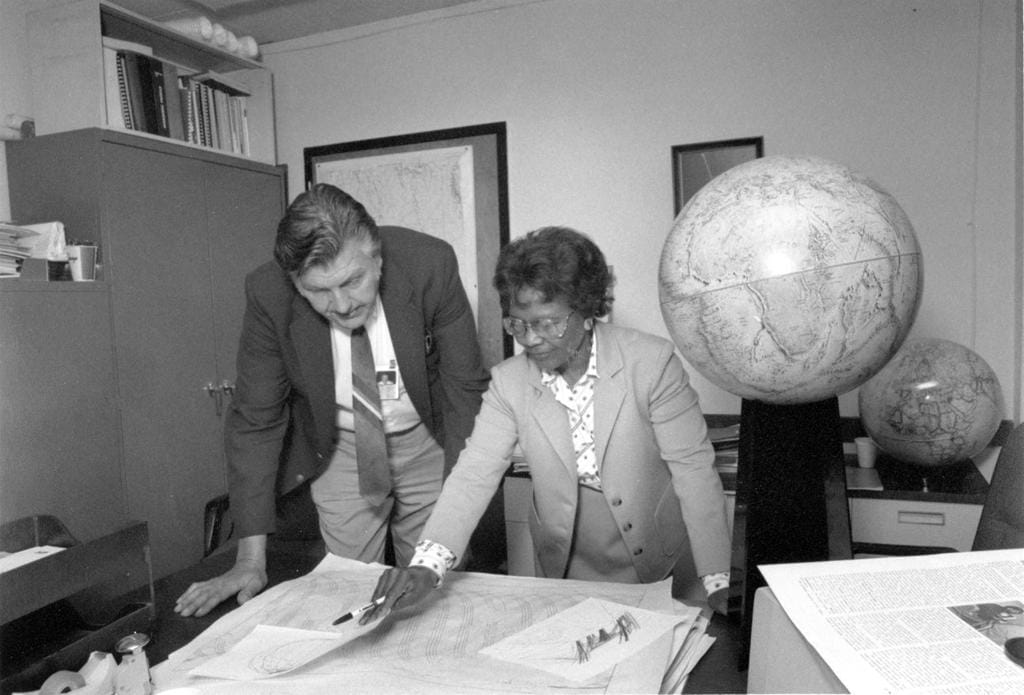
At Dahlgren, Gladys was a computer programmer and project manager for processing systems for satellite data analysis. Still, she wasn’t done with absorbing knowledge: while still working, she earned a second master’s degree — in public administration — from the University of Oklahoma. She also dated one of the three other Black employees at Dahlgren, Ira West. They married in 1957. But what is it she did in her work? She created satellite geodesy models. Er… huh?
Satellite geodesy is the measurement of the form and dimensions of the Earth, the location of objects on its surface, and the figure of the Earth’s gravity field by means of artificial satellite techniques. Specifically, from the mid-1970s through the 1980s, West programmed an IBM 7030 Stretch computer to deliver increasingly precise calculations for the shape of the Earth — an ellipsoid with irregular undulations known as the geoid. To generate a fully accurate model, West needed to use complex algorithms to account for variations in the gravitational, tidal, and other forces that distort Earth’s shape. The data she used to do this was satellite altimeter data, and the final key was the radio altimeter on the U.S. Navy’s Geosat satellite, which reached orbit on March 12, 1984, and was able to measure every bit of the Earth to an accuracy of 5 cm, or 2 inches. West’s work was funded by the Defense Mapping Agency, and was published in a seminal 1986 report authored solely by Gladys B. West. But why? What is such data good for?
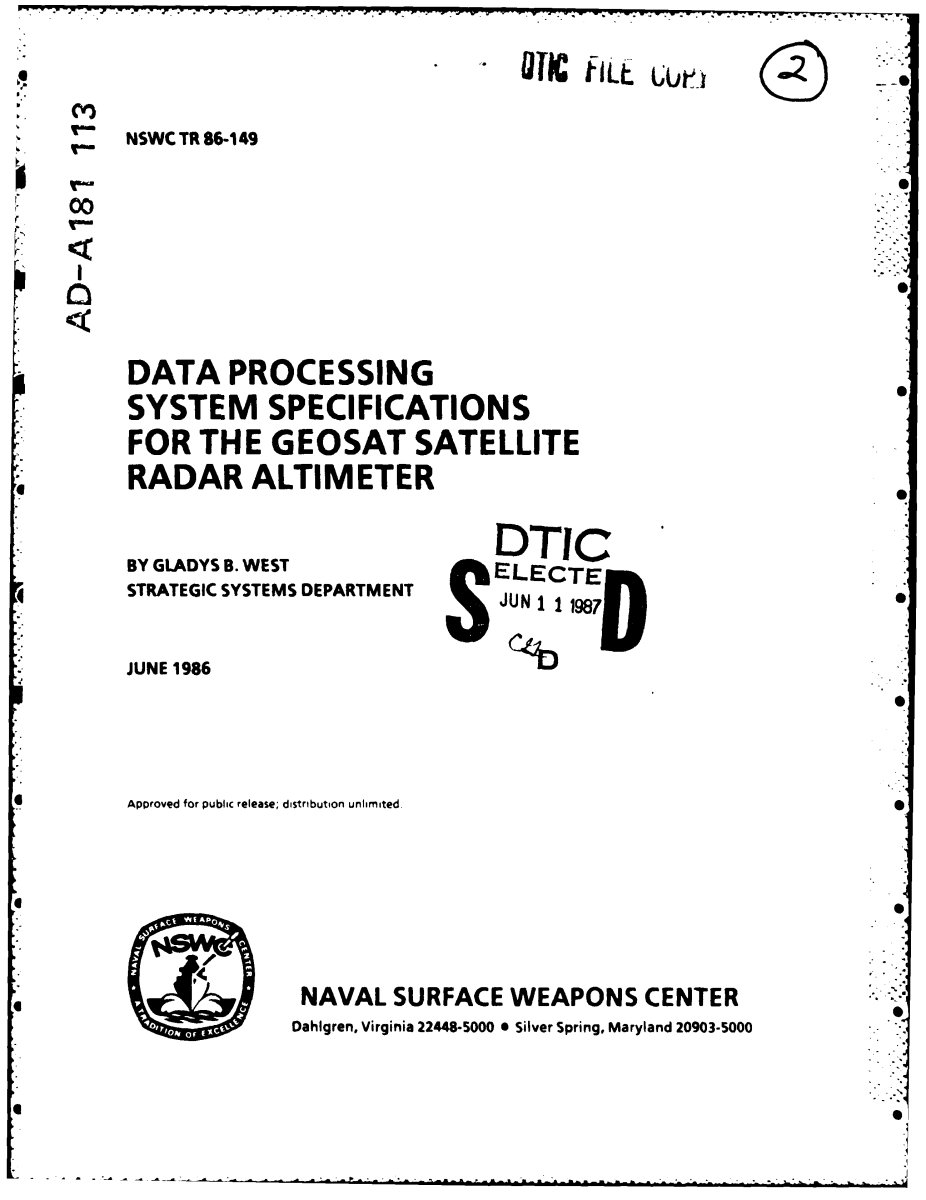
West’s data was the key to improve the accuracy of another, seemingly unrelated project: the Global Positioning System, or GPS. The U.S. Navy wanted accurate GPS capability to increase the accuracy of SLBMs — Submarine-Launched Ballistic Missiles — to ensure other nuclear powers wouldn’t start a war. Hidden missile submarines would not only be able to retaliate, their missile trajectories would be accurate. That was worth the billions that GPS cost, but of course the GPS system proved even more valuable to the civilian economy. “When you’re working every day, you’re not thinking, ‘What impact is this going to have on the world?’,” West said. “You’re thinking, ‘I’ve got to get this right.’” And because she did get it right, GPS works brilliantly.
West retired from Dahlgren in 1998 after 42 years. But she still wasn’t done with education: she had slowly been working on her Ph.D., and retiring meant she would have the time to write her dissertation. Five months after retiring, she had a stroke that impaired her hearing, vision, and balance. After lying in bed for awhile, “all of a sudden, these words came into my head: ‘You can’t stay in the bed, you’ve got to get up from here and get your Ph.D.’!” She and Ira joined the YMCA to get back into shape. It worked: she was awarded her Ph.D. in public administration and policy affairs from Virginia Tech in 2000, at age 70, and went on to receive Virginia Tech’s University Distinguished Achievement Award in 2024. Meanwhile she wrote her autobiography, It Began with a Dream [Amazon *], published in 2020.
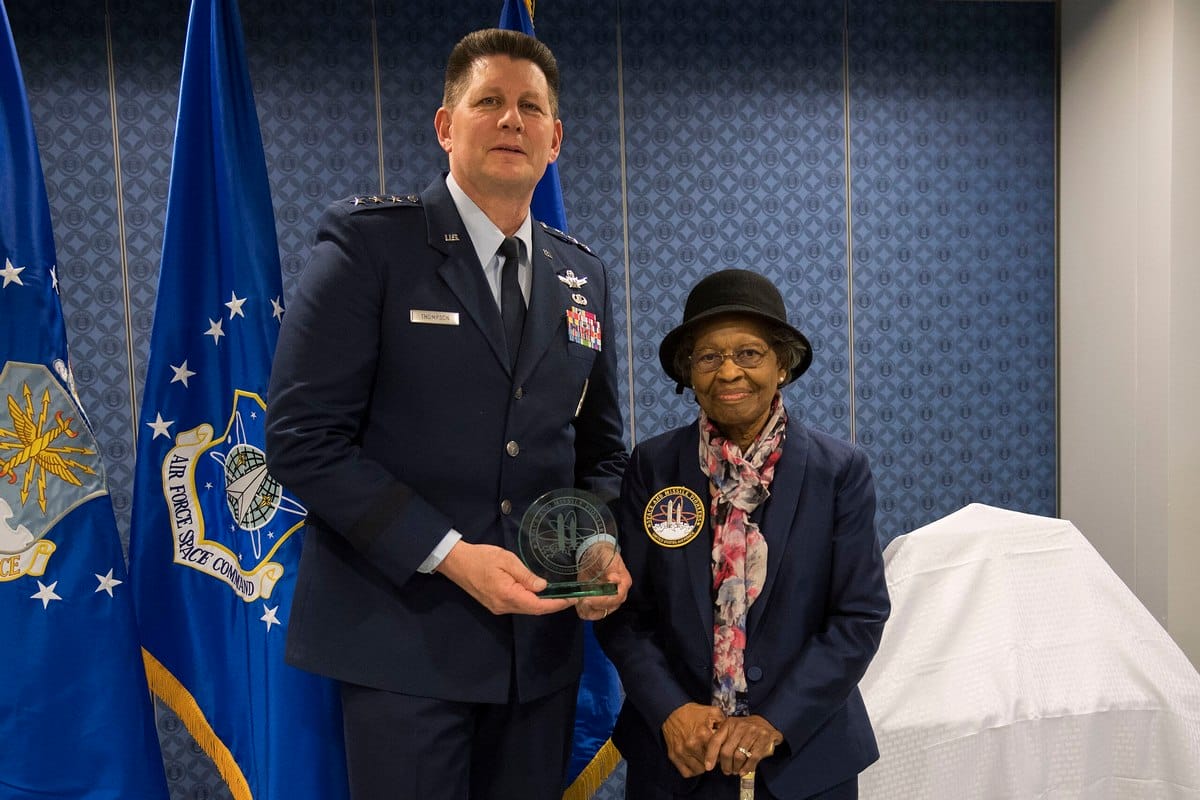
“As Gladys West started her career as a mathematician at Dahlgren in 1956,” said the then-commander of the NSWC Dahlgren, Capt. Godfrey Weekes, “she likely had no idea that her work would impact the world for decades to come.” And it did. It was so profound that West was inducted into the U.S. Air Force Space and Missile Pioneers Hall of Fame in 2018. She was the first Black woman so honored. She was also the first woman to win the Prince Philip Medal from the Royal Academy of Engineering, in 2021. “Her work on precise modeling of the Earth’s surface was relied on by the engineers who realized GPS,” said Prof. Bashir Al-Hashimi, Chair of the Royal Academy of Engineering Awards Committee. “The accuracy that is possible today harks back to the definition of the Earth’s geoid, work that Dr. West achieved using sparse data from early satellites, working with early computers that required elegant, efficient mathematics and extraordinary diligence.”
Still, when West went out, she didn’t use GPS. “I prefer maps.” Dr. Gladys Mae Brown West died in Fredericksburg, Va., on January 17. She was 95.