
Growing up in Los Angeles, Tavoularis’s father was in the coffee business. “We are Greek Americans, and one of [my father’s] clients was Fox studio, which was owned by Spyros Skouras,” he said. “In the summer sometimes I would go with my dad and spend a day going around on his deliveries. We would drive back to the commissary, and you saw stage pieces and ladies dressed in their period gowns. It was a mysterious, magical paradise.” That got him interested in film, and he studied architecture and painting at Otis College of Art and Design. He was hired by Disney as an animation in-betweener — the artist who creates the frames ‘in-between’ the frames that define a scene’s main motions. He worked on Lady and the Tramp (1955), Pollyanna (1960), and The Parent Trap (1961). He also trained there as a storyboard artist — the first visualization of a script, where each scene is sketched out to start the visualization of a film, to help guide set construction and direction. Storyboarding was largely perfected by Disney in the 1930s.
From there, Tavoularis became the production designer for films, starting with director Arthur Penn hiring him for Bonnie and Clyde (1967). The production designer directs the creation of a film’s physical world — the sets, locations, and visual environment — which the cinematographer then photographs as the director shapes the actors’ performances within it. “Dean Tavoularis and Theadora Van Runkle, who designed the costumes, created a whole era,” Penn said, and brought him back in the same capacity for Little Big Man (1970).
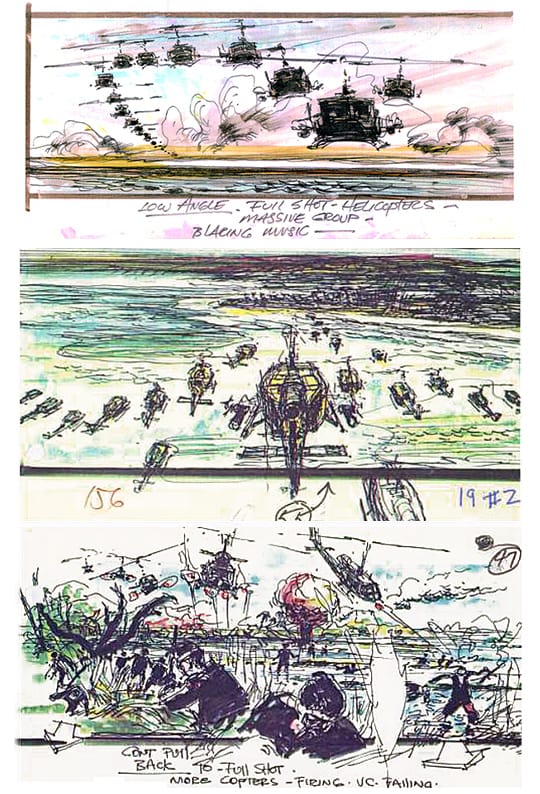
Then director Francis Ford Coppola snapped Tavoularis up, first for The Godfather (1970), then two other films in 1974: The Conversation and The Godfather Part II, the latter bringing him an Oscar. While there were other films in between, Coppola had found his favorite production designer: he brought Tavoularis in for his epic Apocalypse Now, released in 1979. Tavoularis was scheduled to work in the Philippines for 14 weeks; it was such a difficult shoot he was there for two years. “You never had the feeling at the end of the day that it is one day less and you were one day closer to completion,” he said, but he stuck it out. His attention to detail was fanatical: he built the temple used in the film out of real stone.
In all Tavoularis was production designer on 13 films for Coppola. His last film was Carnage (2011) for Roman Polanski. “Like all great collaborations, I began to depend on Dean,” Coppola said in 1997. “This grew into a natural and wordless collaboration, which provided so much comfort to me and added to the style of the films we worked on together.” The feeling was mutual. “There are many partnerships in all different kinds of businesses that can always turn out badly, but sometimes it can turn out to be a collaboration,” Tavoularis said in 2018. “You see eye to eye; you feel supportive. When you’re doing a film, no matter how tough you are, no matter how strong you are, you need a feeling of support. And I always had that with Francis.” Tavoularis’s death is “a profound loss,” Coppola said. “I would be unable to list the many ways he benefited my work and my personal life. He was a great artist, a great friend, a great production designer and a great man.”
Tavoularis died at a Paris hospital on April 22. He was 93.