
A kite-maker, Lynn and his wife Elwyn opened a business in Ashburton, New Zealand, to make kites for children. As time went on, he made bigger, and much more complex, kites, such as giant centipedes, manta rays, octopuses, and more. In 1987 he built a kite that pulled someone over water on skis — which flopped. He switched it to pull a sled over snow or wheeled vehicles over land, which worked so well that it sparked the sport of “kite buggy” riding. He has built more than 10,000 such kite buggies, and a number of other manufacturers have built many more.
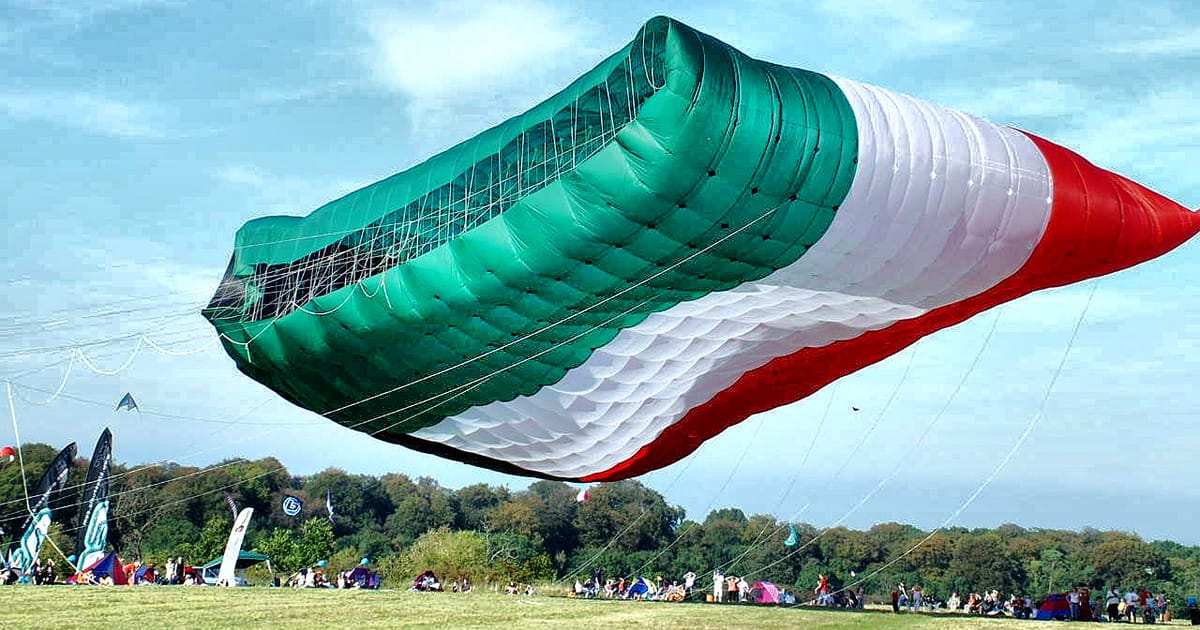
Because he could build very large kites, businesses hired Lynn to build advertising kites — sort of like how airplanes pull banners, but kites are essentially free to operate. To build such large kites, he developed the ‘super-ripstop/thru cord’ ram air kite construction system. In 1995, Lynn created the “Megaray” kite, at 635 sq m (6,840 sq ft), Guinness World Records certified it as the world’s largest in 1997. But Guinness changed its rules to count the tail in the length in 2003, certifying a much smaller kite from China with “a huge tail” as largest, Lynn said at the time.
“The largest kite is based on the amount of lifting area,” he continued, and as an expert in large kites, he should know. “I could make, like on this big flag, this American flag, I could add a 3,000 meter tail if I wanted to, because it’s got a big head so it could lift a big tail.” But that’s not how he beat the record, since in his mind, that would be cheating. Instead, he built another flag kite that he unveiled — and flew — in 2004. On the ground, it was 1,019 sq m (10,970 sq ft), and about 900 sq m in flight. It weighed about 180kg (397 lbs), and depicted Kuwait’s flag. To prove it wasn’t a one-off, he made two more the same size: an American flag, and a “Mega Moon” for Japan. He retook the Guinness Record, and still holds it today. He also made windsurfing kites, and wrote scientific papers to contribute technical knowledge for experimenters.
Lynn wasn’t all about kites: in 1975 he invented the original “tipping blade” portable sawmill system, which automatically rotates its blade by 90 degrees on each pass, allowing lumber to be quite easily made on job sites. When his patent on that ran out, it became the world standard portable sawmill system. He’s best known for kites, however: Peter Lynn Kites still employees 16 kite-makers in Aushburton. He died in that city from cancer on April 11. He was 79.
Video
Cool example of kite buggy racers using Peter Lynn kites near Primm, Nevada.